CHOOSE LOCATION

Hyperchill Applications

Hyperchill Applications

CHOOSE LOCATION

THE WINE INDUSTRY

Global wine production & consumption continue to flourish. Record production levels of 293 million hectolitre were reached during 2018. Europe continues to dominate wine production with Italy, France and Spain accounting for approximately 51% of global production. Precise process cooling is one of the most critical requirements in modern winemaking. The application of cooling during several production steps facilitate high volume production whilst maintaining the unique flavour profile of the final product. Temperature control is also an important factor in wine preservation where consistent quality is required to allow distribution of the product to the global market. Hyperchill and Hyperchill Plus chillers offer a robust and cost-effective solution ideally suited to the exacting cooling demands of the wine industry.

Precision Cooling During Wine Production

Wine making has been around for thousands of years. Many traditional and modern techniques are employed to produce the vast array of wine products found in the market place. There are different approaches required to produce red, white and sparkling wines.

In general, wine production can be split into 5 steps with those being: harvesting, crushing or pressing, fermentation, clarification, aging and bottling.

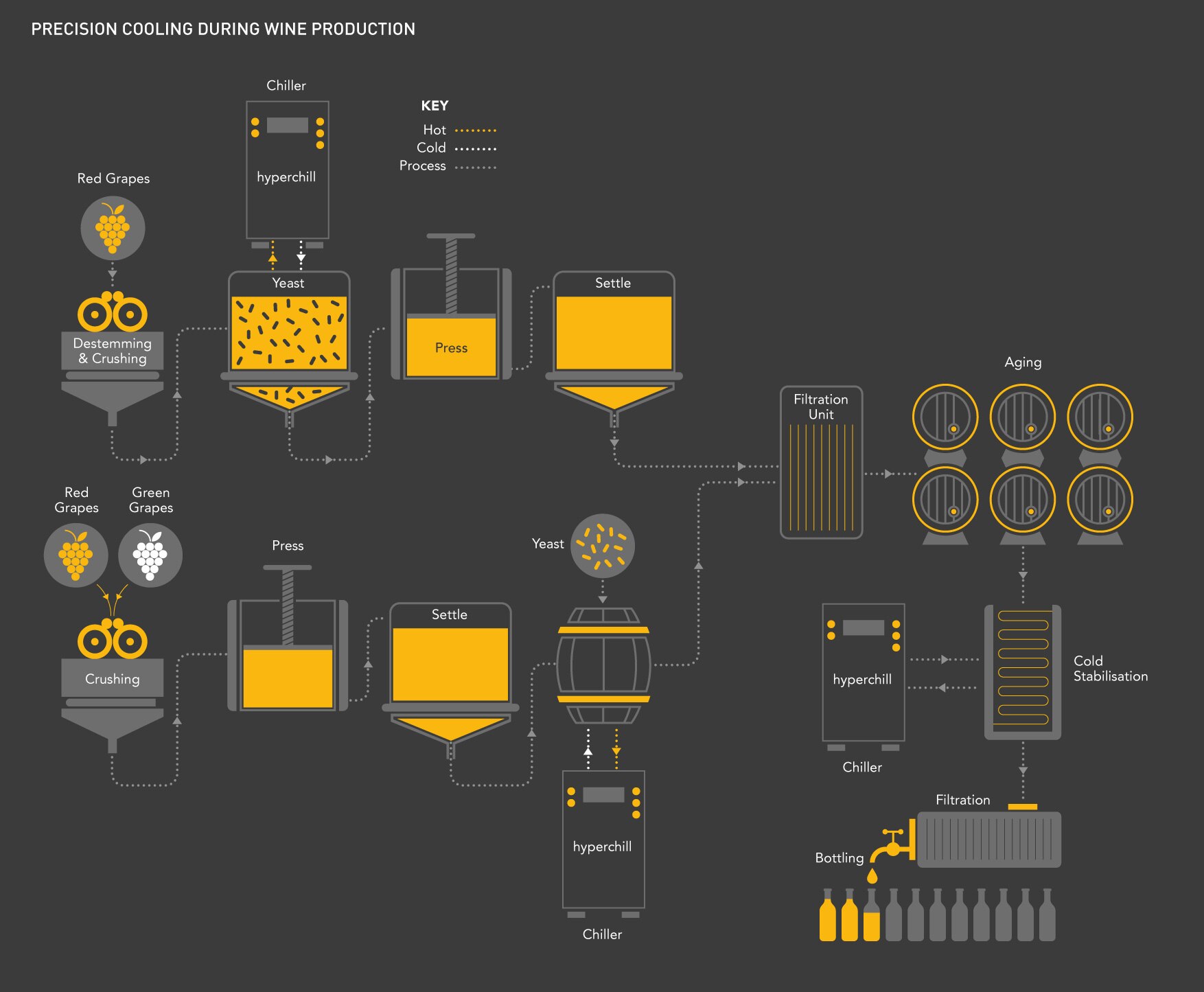
The diagram below details the wine processing stages and where chilling may be applied:

Temperature control through precision chillers may be employed in the following wine processes:
  • Cold Maceration
  • Fermentation Temperature Control
  • Cold Stabilisation / Potassium Bitartrate removal
  • Chilling Prior to Bottling

Cold Maceration

Cold maceration techniques are often employed in the production of red wines. The process is applied prior to alcoholic fermentation and can improve the extraction of taste and colour compounds from the grape skins, seeds and stems into the wine must. Wines manufactured in this way are considered to have more fruit flavours and colour intensity, in addition to reduced tartness.

Cold maceration can be achieved using several methods. Precision chillers, in conjunction with tubular heat exchangers or jacketed vats, are often able to deliver the required cooling capacity. Cold maceration usually occurs between 4-15oC for a period of two to seven days.

FERMENTATION

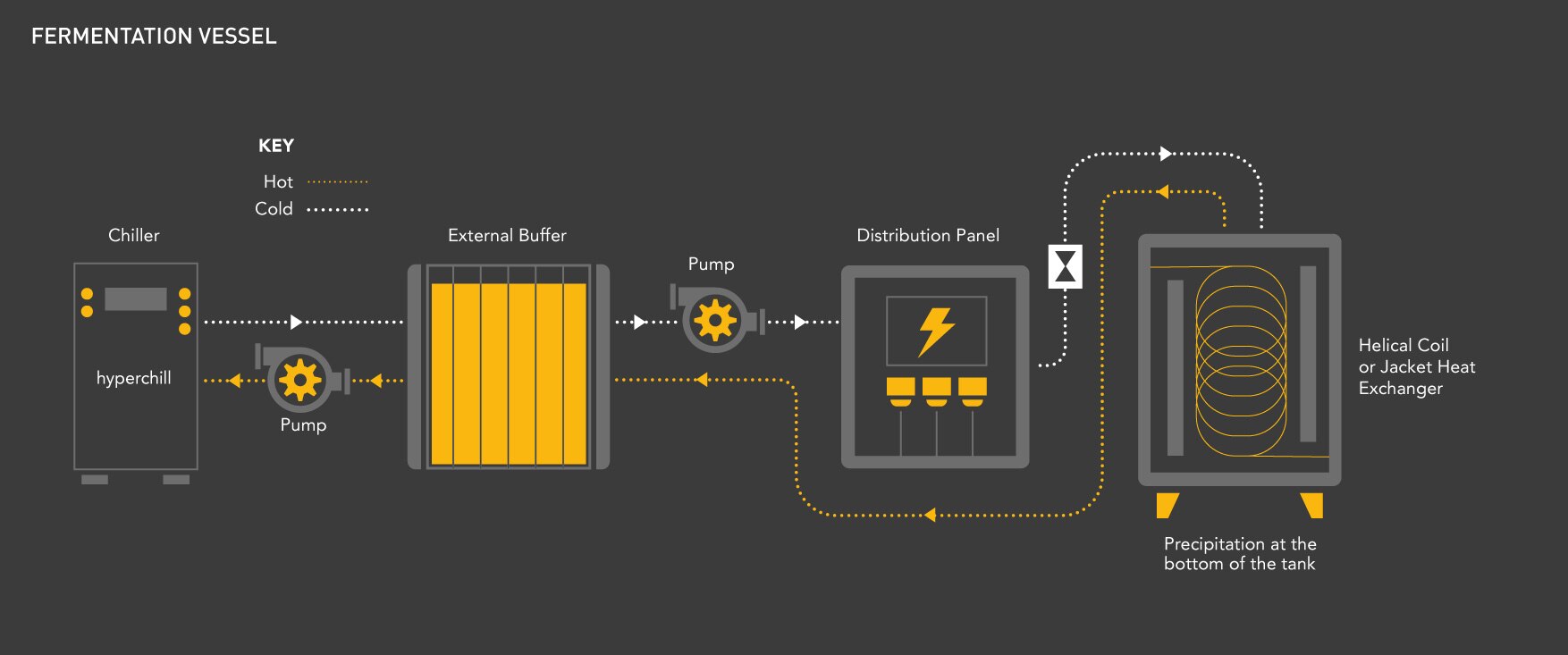
Temperature control of the wine must during the fermentation process is essential in the production of high-quality wines. Alcoholic fermentation is an exothermic chemical reaction in which yeast is used to transform the natural sugars into alcohol.

Optimal fermentation temperatures range between 18-20oC for white wines and 25oC for red wines. If excess heat is not removed from the process fermentation can stop, this can result in a poor taste profile with high sugar content. Additional additives such as Sulphur Dioxide are then required to prevent spoiling during storage.

Precision chillers are generally used to supply the cooling fluid to helical coils or jacket heat exchangers in the fermentation vessel. The diagram below depicts a typical set-up:

Cold Stabilisation / Potassium Bitartrate Removal

At low temperatures, a natural component called potassium bitartrate can crystallise out of the wine and leave sediment in the bottle. The crystals are considered an undesirable component in high quality products.

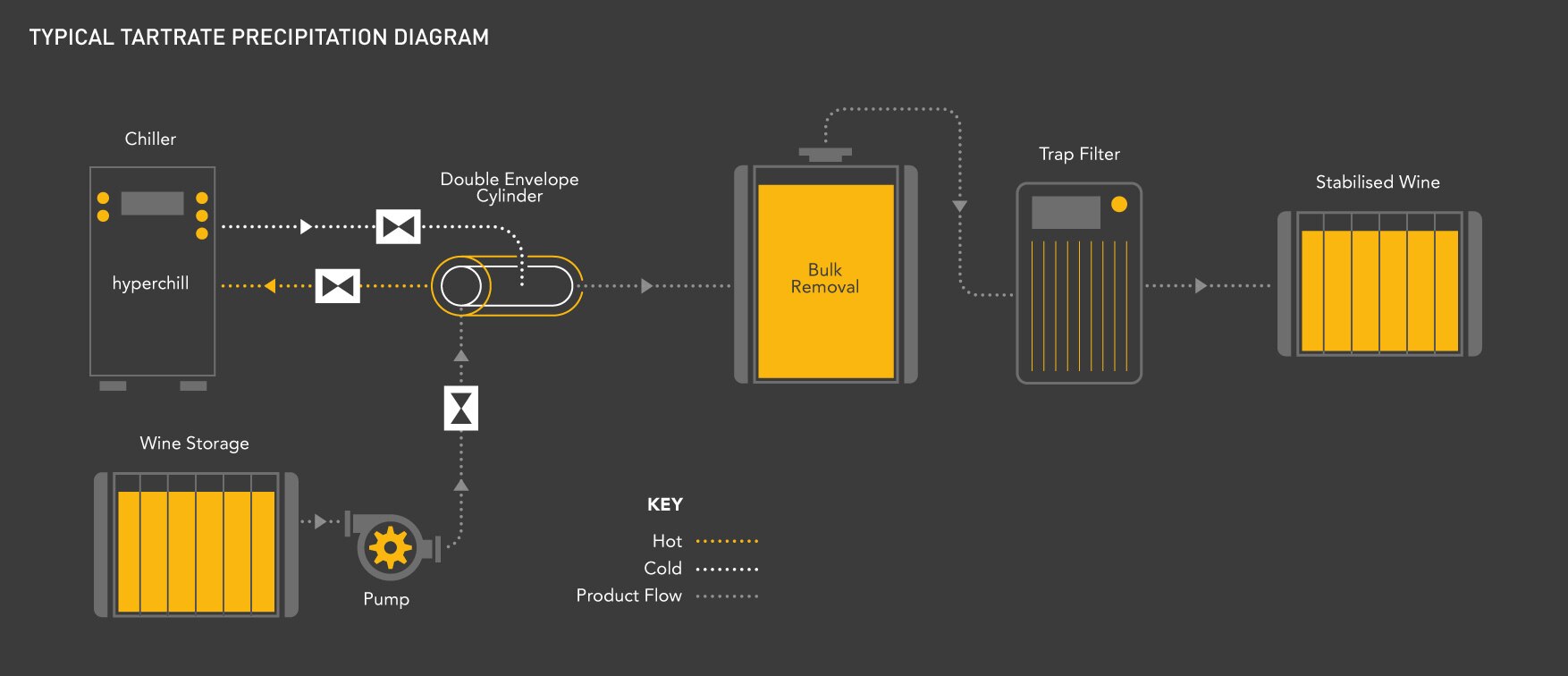
Cold stabilisation is often practised prior to bottling to remove excess potassium bitartrate. The wine is chilled close to freezing point and held at this temperature for up to 48 hours. The low temperatures cause the potassium bitartrate to precipitate out of the solution where it can be filtered off before bottling.

The diagram below shows a typical set up for tartrate precipitation:

Why Parker Chillers

Hyperchill and Hyperchill Plus chillers deliver safe and reliable operation under varied working conditions that can meet the
challenges found in the wine industry.

Key features and benefits for the industry are as follows:

  • Configuration of generously sized water tank coupled with oversized condenser / evaporator allow the chiller to maintain cooling capacity even during rapid load and water temperature changes.
  • High reliability with energy management to reduce total cost of ownership.
  • Stainless steel panel and high IP rating enable ease of operation in wet and humid production environments.