CHOOSE LOCATION

Hyperchill Applications

Hyperchill Applications

CHOOSE LOCATION

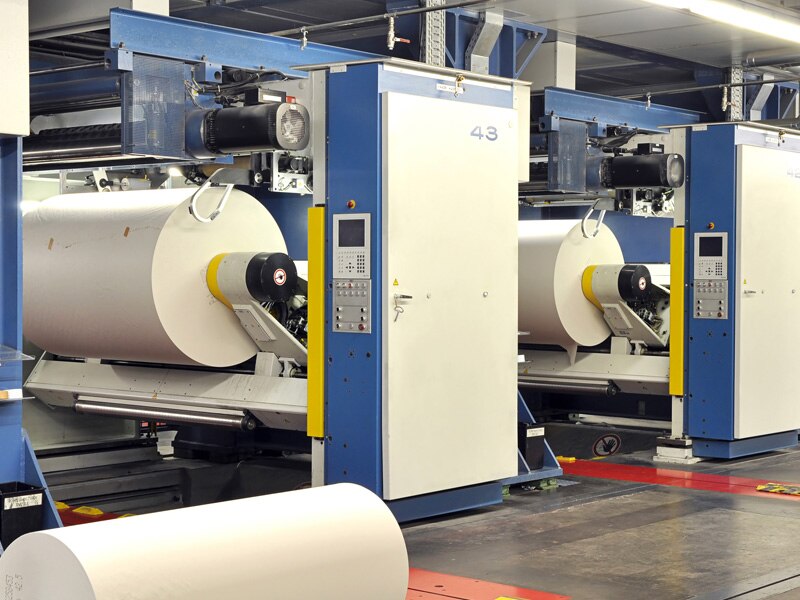
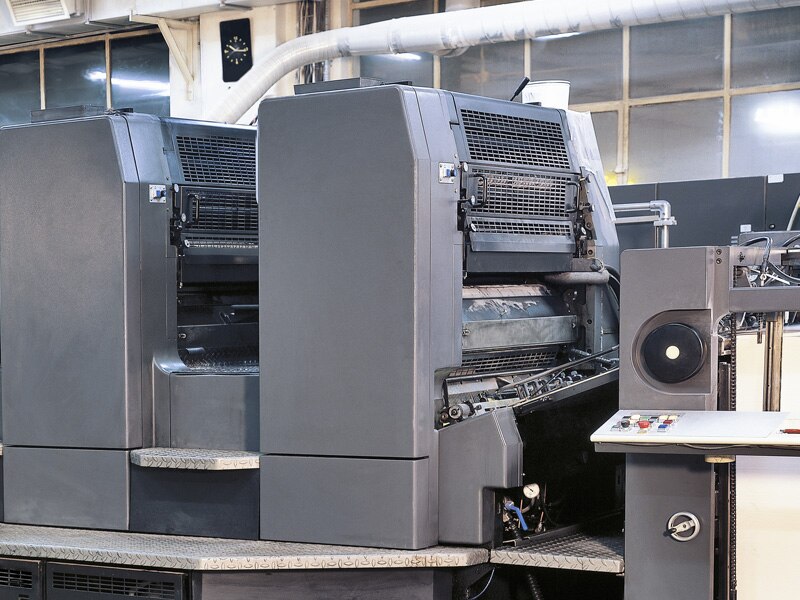
PRINTING INDUSTRY

For the last twenty years the print industry has been on a journey of technological transformation. Printing markets are changing, many publishing products have electronic versions replacing previously printed media. E-books, online newspapers and magazines are taking significant sections of their respective markets, while directories, catalogues and brochures have electronic alternatives.

These factors have seen a shift from the traditional products to packaging and labelling, where demand is growing fast. The print market is forecast to be worth >$800bn in 2020 and continue to grow for the next five years.

The digital age has allowed the machine manufactures to develop systems that are now so advanced that printing companies have been forced to invest in the latest machinery in order to remain viable in the market.

The current key OEMs in the market are:
  • Heidelberg
  • Komori
  • Manroland
  • Edelman


Product designs are now sent online to print companies, who will generally be able to turnaround and deliver finished product within 24hrs. Older methods of waiting for inks to dry have been replaced by UV systems where the ink is instantly cured. The ability to rapidly cure inks has allowed printing machinery to run at higher speeds and significantly increasing productivity.

COOLING IN THE PRINTING INDUSTRY

A consequence of the modern machines running at higher speeds is that they use more energy.

This generally results in the liberation of more heat. In most print applications the excess heat is a problem for the following reasons:
  • At higher temperature the printing ink viscosity decreases. Over emulsification of the ink occurs leading to smearing and smudging of the print
  • Increased quantities of low viscosity ink may be required to achieve the print. The use of larger ink volumes results in increased print costs
  • High heat levels increase the wear on the printing system resulting in more frequent maintenance work

Chillers play an essential role in printing applications. They are vital in providing the machinery with temperature stability, which is in-turn, critical to ensuring the quality and speed of production is maintained.

Most machine manufacturers circulate chilled water through the critical components to reject the unwanted heat and provide stable working temperatures.

The heat load is generally removed by circulating chiller water through the print roller or through the UV curing lamps.

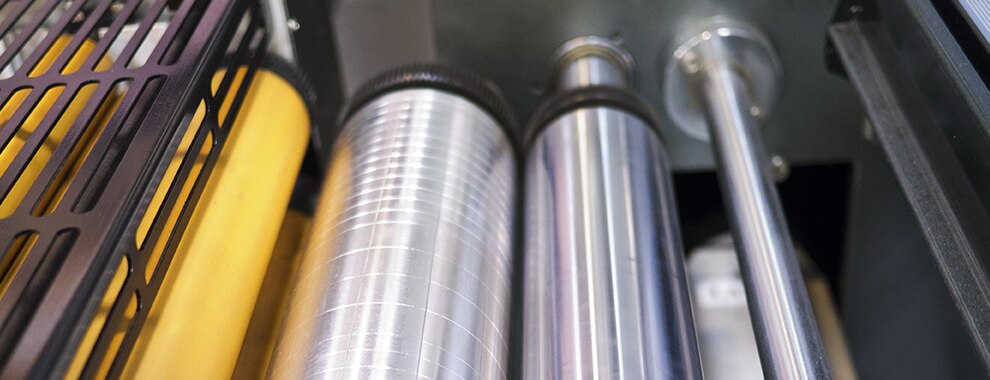
Direct Cooling of Rollers

Chilled rollers provide cooling directly to the product to maintain consistency of throughput. The chilled water passes through rotary unions at each end of the roller.

Cooling of UV & LED Lamps

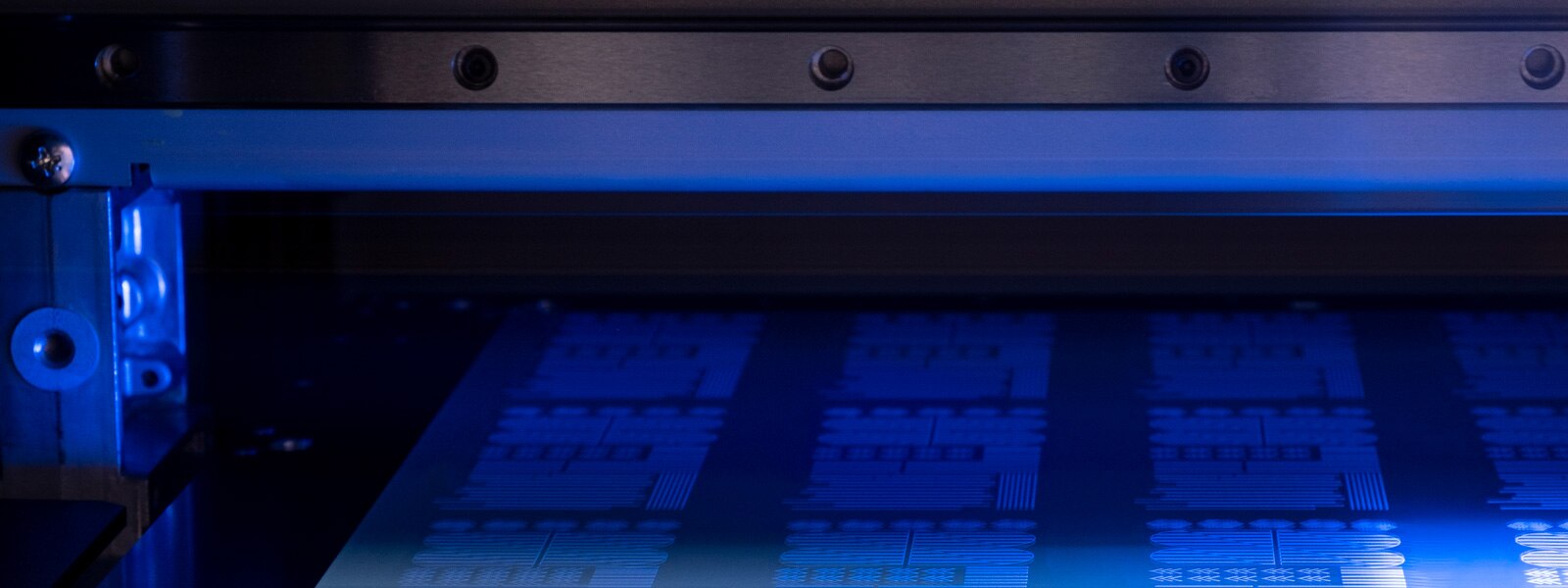
UV and LED Lamp Systems are used to create ultra violet light that can be directed onto the printing surface. The UV light reacts with the wet ink resulting in rapid curing and drying. The UV curing method is common in modern and large print systems as the printing throughput can be significantly increased. Chilled water is typically passed through a heat-sink attached to the bulb mounts and maintains a stable operating temperature.


COOLING IN LARGE PRINTING OPERATIONS

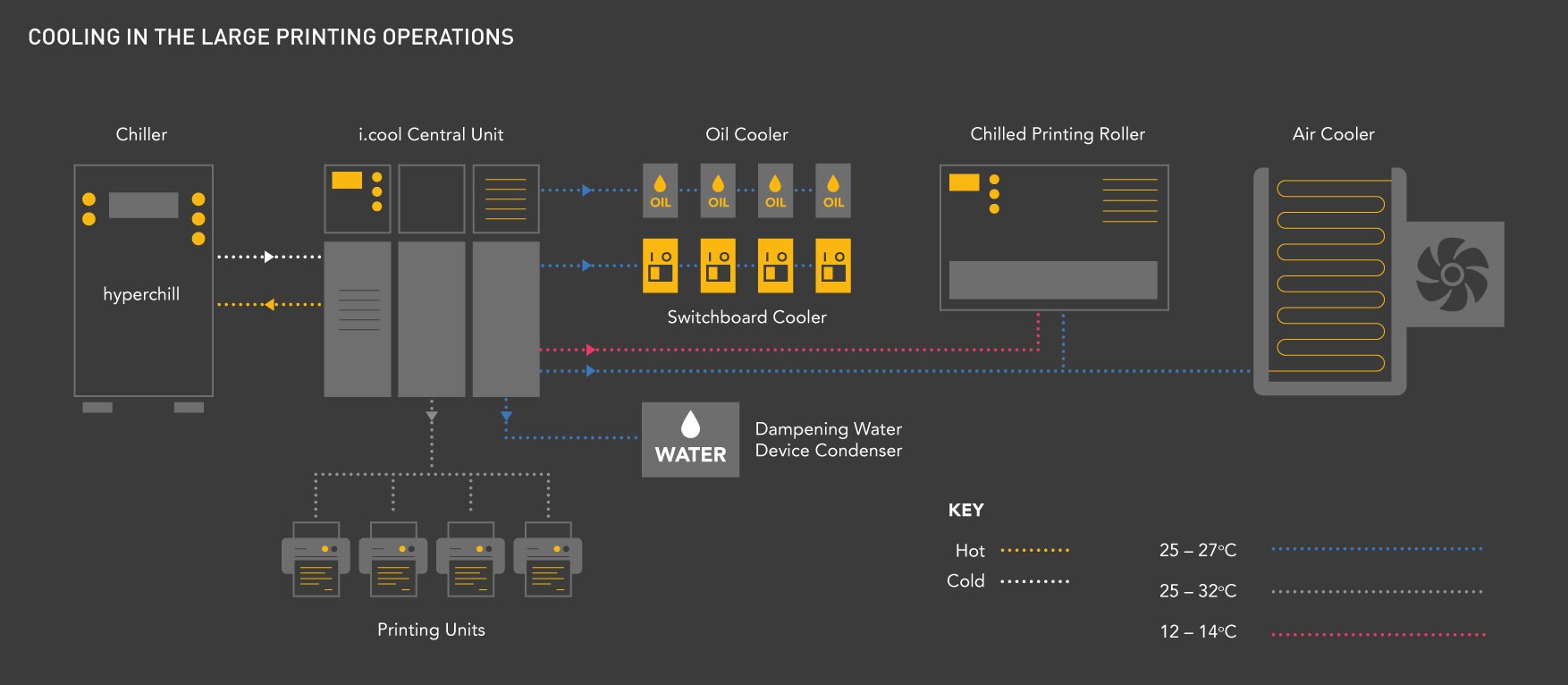
Larger printing systems often adopt a centralised system, where an integral heat-exchange unit is used to control the cooling of individual components in the line. An externally located chiller is then used to provide primary cooling to the integral heat-exchange unit.

The diagram below depicts a typical large printer installation:

The Hyperchill and Hyperchill Plus chillers offer a robust and cost-effective solution, ideally suited to this application.

In many instances, the complete print line is supplied by an integrator that packages a number of OEM systems to provide the customer with the required solution. Ink curing through UV lamps is commonly employed in these larger lines. Hyperchill and Hyperchill Plus chillers offer a robust and cost-effective solution and are ideally suitable to meet the cooling demands from a UV based system.


Why Parker Chillers

Hyperchill and Hyperchill Plus chillers deliver safe and reliable operation under varied working conditions, like those typically found in the printing industry.

Design features on the Parker’s chillers can deliver significant benefits to the end users. Some key features and benefits for printing are as follows:

  • Non-ferrous hydraulic circuit with stainless steel tank, evaporator and water pump maintain the quality of the coolant.
  • Very precise outlet water temperature control (up to ± 0.5 °C), thanks to a PID software developed and tested to give the highest temperature consistency even at variable loads.
  • Medium-high pressure pumps supply constant water flow and pressure to the machine.
  • High reliability, with energy management, to reduce total cost of ownership.